

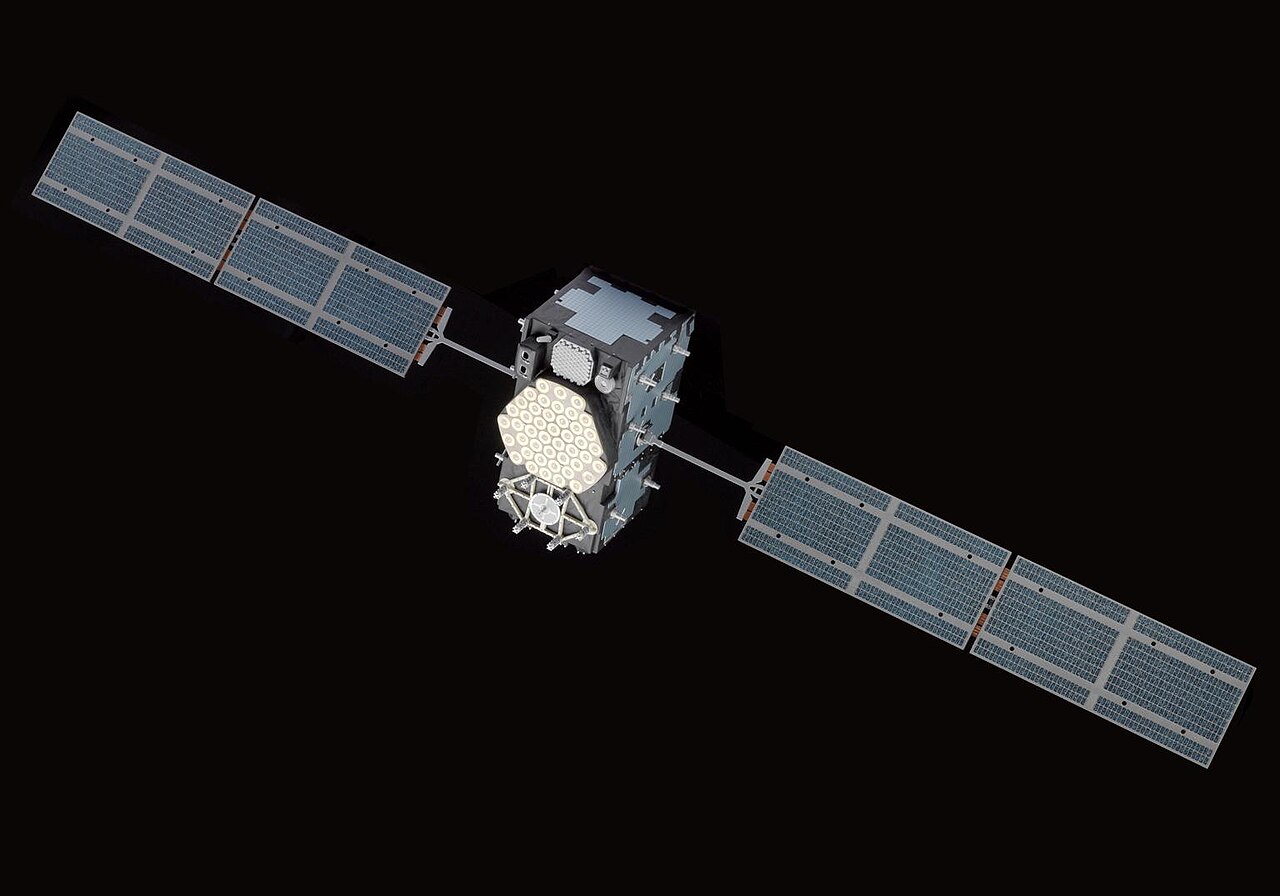
Europe has spent nearly six years arguing about whether it needs its own satellite internet. That argument is over. On 7 August the European Commission and the SpaceRISE consortium closed the negotiations known as Rendezvous 1 and signed an implementation agreement for IRIS², the EU's sovereign secure-connectivity constellation. The programme moves from design to build.
The headline change is size. The agreement adds a dedicated layer of 66 satellites in low Earth orbit, taking the main constellation to 348 — 330 in low Earth orbit and 18 in medium Earth orbit, with optional elements on top. According to the Commission, that extra layer will increase secure governmental capacity by 60% within the Union and 54% globally. When the 12-year concession contract was signed in December 2024, the design called for 290 satellites.
The Commission's own explanation is blunt: the security environment changed. The 66 additional satellites are described as a layer built specifically for defence, security and emergency services, designed with enhanced resilience. This is no longer framed as a commercial broadband play with a government annex. It is a military and civil-protection asset that will also sell capacity.
"Today we are taking a decisive step forward for Europe's security and digital sovereignty," said Andrius Kubilius, the European Commissioner for Defence and Space, in a statement issued alongside the agreement. He argued the reinforced architecture would bring the network into operation ahead of schedule and boost secure governmental capacity "by more than 60% within the Union."
Josef Aschbacher, Director General of the European Space Agency, put it in terms of capability rather than kit. IRIS², he said, "is a clear answer to Europe's needs for sovereign and secure connectivity," and hitting the Rendezvous 1 milestone "demonstrates Europe's ability to deliver a secure and resilient capability that enables independent action and safeguards its essential interests."
Strip out the institutional language and the subtext is simple. Europe's governments, armies and emergency services currently depend on satellite networks they do not control. The most capable of those networks is owned by a single American company. IRIS² is the attempt to buy an exit from that dependency, and the price of the exit just went up.
The Commission concedes that faster deployment and more satellites mean more money. The extra investment, it says, will come from a combination of EU budget resources for 2028–2034 and additional contributions from member states and third countries — which means the bill lands inside the next Multiannual Financial Framework, a negotiation that is already the most contested file in Brussels.
Some member states are not waiting. Poland has committed €656 million and Hungary €500 million. Spain has announced investments between €1.6 billion and €2 billion. Further national contributions are under consideration, with agreements being finalised. That pattern matters: national money buys national industrial participation, and the countries writing cheques early are positioning their space sectors for the work packages that follow.
The industrial line-up is the other story. The Commission names Airbus Defence and Space, Thales Alenia Space and OHB — the incumbents — and alongside them Aerospacelab, a Belgian manufacturer founded less than a decade ago. Handelsblatt reported on 17 August, citing several sources, that Aerospacelab has been assigned the bulk of the constellation, some 264 satellites, in a contract worth around €1.8 billion, and that Airbus lost out in the competition for that work. The Commission has not published the industrial split, and neither Aerospacelab nor Airbus has confirmed the figures.
If the reported split holds, it is the most interesting thing about the whole agreement. Aerospacelab is completing a satellite factory in Charleroi with an annual capacity of up to 500 spacecraft — on its own account, the largest satellite manufacturing site in Europe. Handing a sovereign security programme to a young company with an unproven production line at that scale is a genuine risk. It is also the first time an EU flagship space programme has been built around volume manufacturing rather than around the firms that have always built European satellites one at a time.
Everything above depends on a date. The agreement commits to first launches in 2029 and progressive service from that year onward. Starlink already has thousands of satellites in orbit and is adding more every month. Amazon's Kuiper is deploying. China is building its own constellations. By the time the first IRIS² satellite reaches orbit, the market it was designed for will look nothing like the market of 2020, when the programme was conceived.
That is the standard criticism, and it misreads what IRIS² is for. Nobody in Brussels expects the constellation to compete with Starlink for consumer subscriptions. IRIS² will serve authorised governmental users across member states plus Norway and Iceland, and the value of that service is not bandwidth per euro. It is that no foreign executive can switch it off, throttle it, or make its continued operation a bargaining chip in someone else's negotiation.
The next steps are procedural but revealing: finalising the detailed satellite design, preparing construction of satellites and secure ground infrastructure, and — the item that will decide whether 2029 holds — securing launch services. Europe's launcher capacity is itself a constrained resource. A constellation of 348 satellites needs a lot of rides to orbit, and the Commission has not said where they will come from.
IRIS² has crossed the line where a European programme usually fails. It is funded, contracted, and now legally committed to a build schedule with named manufacturers — the stage at which the Galileo navigation system, for all its delays, became irreversible. The expansion from 290 to 348 satellites is not a technical footnote; it is Europe deciding that secure connectivity is defence infrastructure and pricing it accordingly, in the same year that defence budgets across the continent are being rewritten upward.
The open questions are the ones the agreement does not answer. The Commission has not put a number on the additional investment, which leaves it to the 2028–2034 budget fight. It has not published the industrial split, which leaves the most consequential decision — whether to bet a sovereign security asset on a young manufacturer's factory floor — to be reported rather than explained. And it has not said how 348 satellites get to orbit. Europe has decided it wants its own sky. It has not yet shown how it gets there.



_(cropped1).jpeg)


