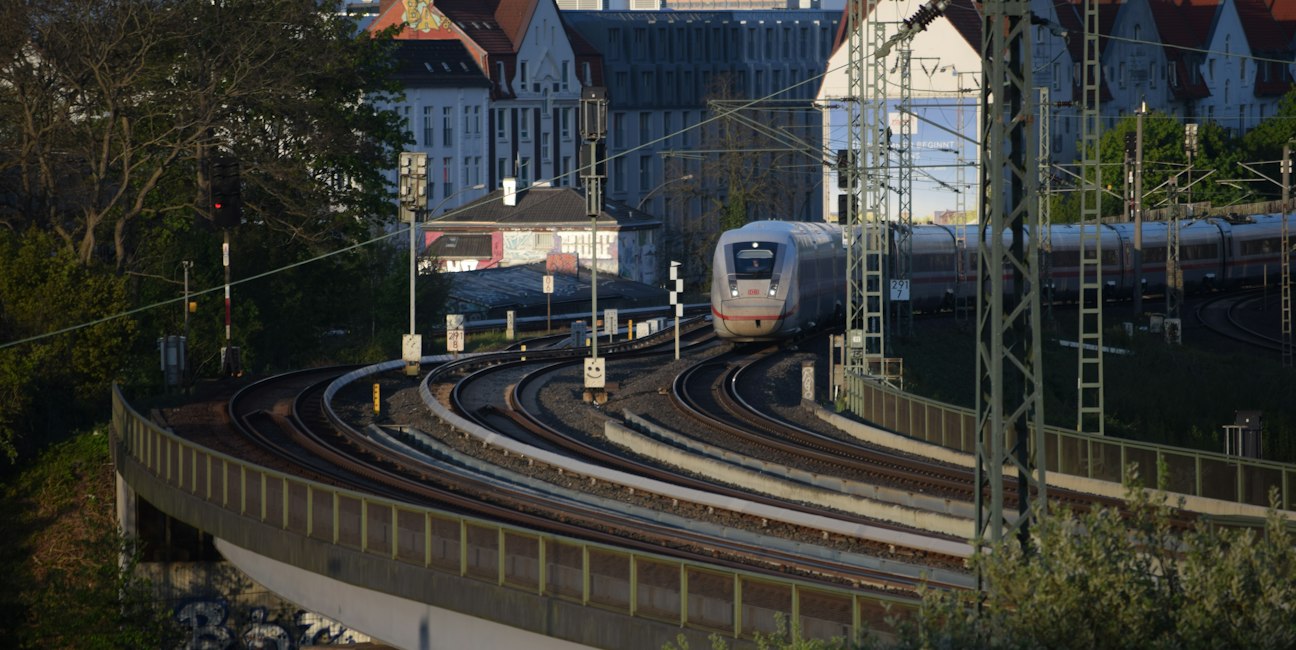
Rail is where Europe's single market meets its oldest borders. According to the industry, around half of all rail freight crosses at least one national frontier, yet capacity on the network is still planned country by country. On 20 May 2026 the European Parliament and the Council adopted Regulation (EU) 2026/1184 to change that. It was published in the Official Journal on 10 June and entered into force on 12 June.
The Draghi Implementation Index, run by the European Policy Innovation Council (EPIC) at draghiwatch.eu, tracks how many of the 383 measures in Mario Draghi's competitiveness report have become binding EU law. Its July 2026 update puts the strict rate at 15.7% (60 of 383 measures) and the strict-plus-partial rate at 41.3% (158 of 383). Rail is one of the places where EPIC found real movement.
EPIC's analysts say the regulation replaces fragmented capacity allocation with a directly applicable framework covering strategic capacity planning, allocation, coordination, disruption management, performance review and oversight. It also requires interoperable digital tools for capacity and traffic management, and cross-border access through single-interface systems. EPIC is careful to add that this does not complete the rail agenda. It does give the EU, in its words, a stronger basis for a more integrated rail system.
In the July update, the transport sector covers 41 Draghi measures. Eleven are fully implemented and ten partially, which gives 21 measures and a strict-plus-partial rate of 51.2%. That is well above the 41.3% for the agenda as a whole. It is far behind defence, at 78.6%, but ahead of automotive (50.0%) and critical raw materials (47.4%), and far ahead of energy, at 21.7%.
The index also scores the Commission department responsible for each measure. DG MOVE holds 44 measures: 11 implemented and 12 partial, with 13 in progress and 8 not implemented. That is a strict rate of 25.0% and a strict-plus-partial rate of 52.3%. It puts DG MOVE fifth of twelve directorates-general with at least ten measures, behind DG TRADE, DG ENV, DG INTPA and DG GROW. EPIC cautions that the ranking is an accountability signal, not a measure of effort.
The regulation repeals Regulation (EU) No 913/2010 on rail freight corridors and amends Directive 2012/34/EU. It replaces the corridor logic with a process that covers both domestic and international services: strategic capacity planning, then scheduling and allocation, then adjustment when plans change. Infrastructure managers stay responsible for allocating capacity. What changes is that they must do it through common European frameworks.
Those frameworks are the job of the European Network of Infrastructure Managers (ENIM), which gains decision-making power by a two-thirds majority and a network coordinator to run its secretariat, alongside an advisory performance panel of independent experts. The market has already moved to claim a seat. Rail operators' and freight users' associations, including CER, ALLRAIL, ERFA and UIRR, jointly proposed a European Railway Platform as the voice of customers, a counterpart to ENIM.
The calendar is the story. The regulation's tools arrive in stages across 2027 and 2028, and the full effect comes only with the timetable change in December 2030, when the first timetable built under the new rules takes effect. A trade-press analysis of the reform warned that if national IT systems stay fragmented, the reform risks staying too theoretical.
That matches the pattern EPIC sees across the whole agenda. Most new progress, it says, consists of frameworks, monitoring systems, digital platforms and review obligations. These are legally durable, but they are not the system-wide execution Draghi called for. Where pressure is highest, such as defence, the EU moves fast. Where delivery depends on dozens of national managers agreeing a calendar, it moves at the speed of a rail timetable.
The index counts adopted law, not train movements, so the 51.2% for transport describes legislation, not punctuality. That is a fair rule, and rail shows why it matters. The law is in force; the benefit is four years away.
For anyone shipping goods by rail, the dates to watch are the ones before 2030: the network coordinator and market platform, the digital tools due by the end of 2027, and the common frameworks that decide whether the new process works in practice. If they slip, transport's high score will look like the Draghi agenda in miniature: strong on paper, slow on the track.