On Friday evening, riot police ringed the Constitutional Tribunal in Warsaw. By Saturday, Poland had a court with two competing leaderships, a president who had abandoned a state visit, and a government accused of a coup by half of Europe's populist right.
Judge Anna Korwin-Piotrowska, elected to the tribunal by parliament this year, ordered the suspension of its president, Bogdan Święczkowski, and his deputy, Bartłomiej Sochański. Both are close to the opposition Law and Justice party (PiS) and to Nawrocki. She said Święczkowski had been blocking new judges from taking up their posts. Justice Minister Waldemar Żurek separately asked the tribunal to lift the immunity of both men so they could face prosecution.
Police stopped Święczkowski from entering after his supporters cut through a fence. Seven of the newly elected judges went in through a gate linked to the prime minister's chancellery, escorted by State Protection Service officers. The court's own social media account called it an unlawful takeover and a coup d'état. Nawrocki, flying to Senegal, ordered his plane back, reached the building overnight and pushed past security to get inside. PiS leader Jarosław Kaczyński called Poland a police state. Protests followed in Warsaw over the weekend.
The fight is a decade old. After PiS took power in 2015 it packed the tribunal with loyalists, and both the EU's Court of Justice and the European Court of Human Rights found the court's independence had been violated. That is why Brussels opened an Article 7 rule-of-law procedure against Poland.
Donald Tusk won the 2023 election promising to undo it. He has been stuck since. Nawrocki, elected president in 2025, has vetoed his reforms, and Tusk lacks the two-thirds majority to change the constitution. Parliament this year chose eight new judges. Nawrocki refused to swear in five of them. The European Court of Human Rights ordered that the five be allowed to serve. Święczkowski, who runs the court, said it had no authority to do so. Legal scholars are divided, and at least one prominent constitutional lawyer argues the suspension had no legal basis.
The European Commission backed the government. Rule of Law Commissioner Michael McGrath said it is the Polish parliament's right to appoint judges. That was close to unavoidable, since the Commission has told Tusk to restore judicial independence as the price of closing the Article 7 case.
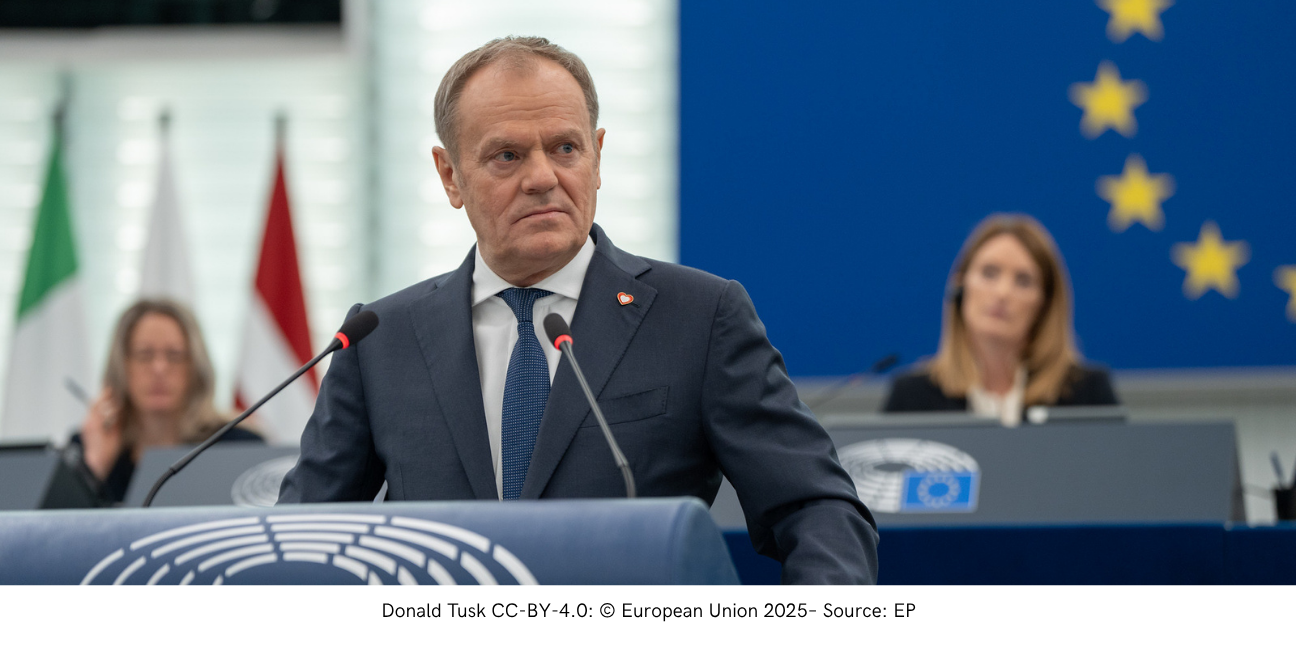
It also handed critics their line. Le Pen called it a forced takeover of the judiciary. Farage said it defended an undemocratic EU. Dmitri Medvedev said a constitutional coup had happened. Foreign Minister Radosław Sikorski replied that the real attempt to seize power is Nawrocki's, and that Moscow is amplifying PiS's message. Tusk, in a televised address, compared the situation to a thief who shouts about violence when caught with a stolen handbag.
Tusk may be right on the law and still be losing the argument. Pictures of riot police escorting judges past a president make the same story for anyone who knows nothing of 2015. Hungary's Péter Magyar had it easier because he commands a large majority and appoints the president. Tusk has neither.
Watch three things. Whether the tribunal's rulings are treated as valid by courts and ministries while two leaderships claim the court. Whether the Commission says more once it studies the legal route used. And whether Nawrocki, who has the veto, escalates, since he can stall most of what the government needs to finish the job.