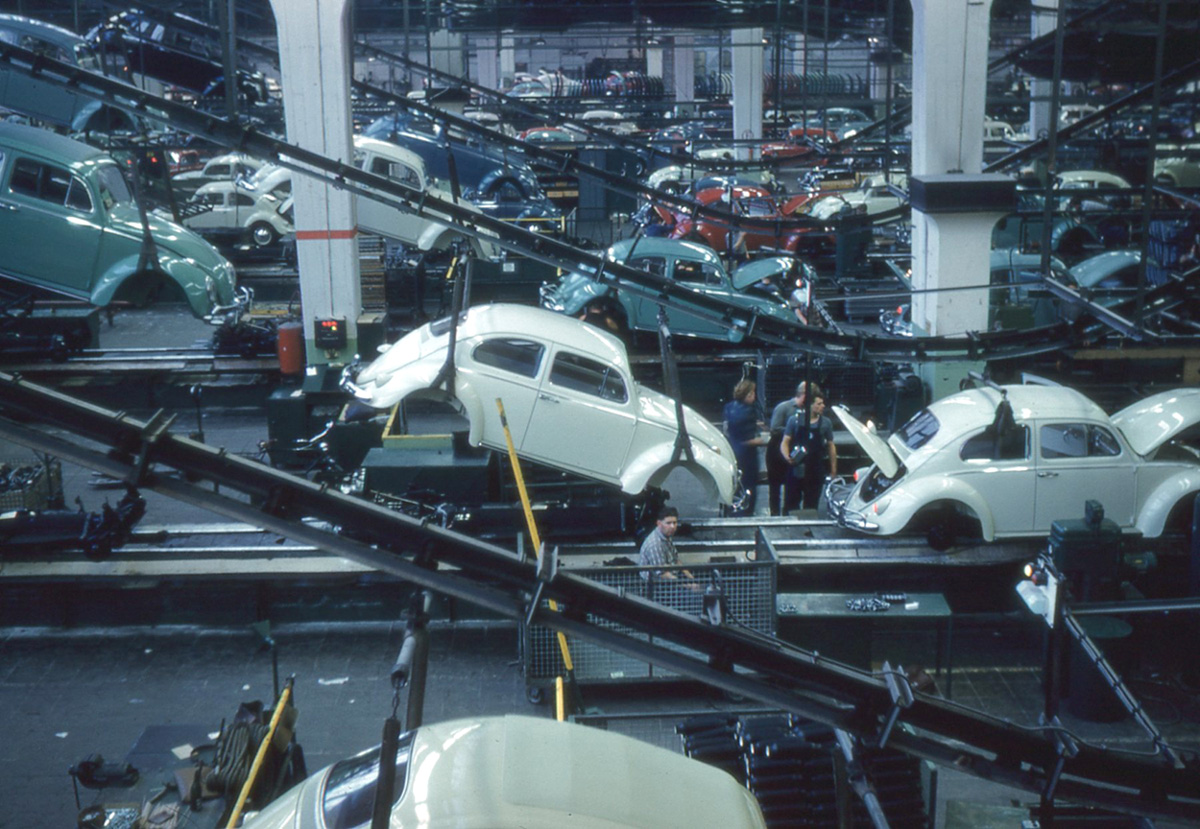
Europe's largest carmaking workforce is now smaller than at any point in the last two decades. At the end of the first half of 2026, Germany's automotive industry employed 691,500 people — 42,300 fewer than a year earlier, according to figures published by the Federal Statistical Office (Destatis) in press release N057 on 14 August 2026. The 5.8% fall was the steepest recorded in any German industrial branch employing more than 200,000 people, and the sector has not been this small since 2005.
That single number carries more European weight than most national statistics. Germany builds roughly a quarter of the cars made in the EU, and the argument now running through the Council and the European Parliament over the 2035 carbon target for new vehicles is, in practice, an argument about what happens to plants and supply chains like these.
Destatis breaks the industry into three parts, and they are not moving together. Manufacturing of cars and car engines fell 6.1% to 429,200. Manufacture of parts and accessories — the supplier base — fell 7.6% to 219,500, the worst performance in the sector. The smaller segment covering bodies, superstructures and trailers went the other way, rising 10.0% to 42,800.
The wider picture is bleak but less dramatic. German manufacturing as a whole employed 5.29 million people, down 144,100 or 2.7% over the year. Metal products fell 3.8% to 471,700, basic metals 3.7% to 207,200, chemicals 3.6% to 312,000 and electrical equipment 3.4% to 374,500. Mechanical engineering, still the largest industrial employer at 905,900, fell 2.7% — exactly the manufacturing average. Plastics (-2.2%), food (-1.3%) and computers and electronics (-1.0%) did better.
Two methodological caveats matter before anyone builds a policy on this. The data come from the monthly manufacturing survey, which only covers plants with 50 or more employees, so the smallest suppliers are invisible in it. And Destatis notes that firms shifting their main activity can be reclassified into a different branch, which moves headcount between categories without anyone being hired or fired. Neither caveat is large enough to explain a 5.8% drop.
The standard explanation for shrinking car employment is that electric vehicles need fewer parts and fewer hours to build, so a smaller workforce is simply the transition arriving. That explanation requires the transition to be arriving quickly. It is arriving, but not that quickly — and the market it is arriving into is growing.
Figures from the European Automobile Manufacturers' Association show 1,220,890 new battery-electric cars registered in the EU in the first half of 2026, or 20.7% of the market, up from 15.6% a year earlier. Hybrids took 37.3% and plug-in hybrids 9.8%. Total EU registrations rose 5.7%. Three of the four largest markets drove the electric growth, with Germany up 48%, France up 62.9% and Denmark up 41.2%.
So European drivers bought more cars in the first half of 2026 than in the first half of 2025, and a rising share of them ran on batteries. Employment in the industry that is supposed to build those cars fell anyway, and fell fastest among the suppliers. That points less to a demand problem than to a location problem: the value in an electric car sits in cells, power electronics and software, and a large part of that content is not being made where the combustion content used to be made. A shrinking payroll in a growing market is a statement about where the work went, not about whether the work exists.
The political response ran ahead of these numbers. In December 2025, after sustained lobbying from the industry and the centre-right, the European Commission proposed replacing the 100% CO2 reduction requirement for new cars from 2035 with a 90% requirement — which removes the effective prohibition on selling combustion engines after that date. Plug-in hybrids, range extenders and mild hybrids would be allowed to continue, with manufacturers required to offset the remaining emissions using EU-produced low-carbon steel or sustainable fuels. The file passed to the Parliament and the Council, with the Cypriot presidency taking on the political negotiation from January 2026.
The concession has therefore already been granted, at least at proposal stage, and the jobs went anyway. That is the uncomfortable fact sitting underneath the current negotiation. Industry associations and much of the German centre-right read the Destatis figures as proof that European regulation — the 2035 target, fleet-average penalties, mandatory driver-assistance systems, permitting — has made the continent an expensive place to build cars, and that further flexibility is the remedy. Environmental groups and much of the charging and battery industry read the same figures the other way: that a decade of shifting deadlines is precisely what deterred the European investment in cells, chemicals and software that would have kept the value chain at home, and that reopening the target again in 2026 hands the next decade of that investment to Chinese manufacturers who have no such ambiguity to plan around.
Both readings are arguments about certainty rather than about ambition, and neither has been tested. What is now measurable is that the workforce shrank 5.8% in the year that Brussels moved towards the industry's position.
The trilogue on the 2035 target will be conducted in the language of climate ambition, but the number that will be quoted in every room is an employment number. Germany's car industry is still the second-largest industrial employer in the country and one of the largest in the Union, and it has just posted the worst annual fall of any major branch while its end market grew. That combination removes the easiest political explanation from the table. If sales are up and headcount is down, the question stops being whether Europeans will buy electric cars and becomes whether Europe will build the parts of them that are worth building. Loosening the 2035 target changes what may be sold in Europe in nine years' time. It does not, by itself, change where a battery cell, an inverter or a piece of vehicle software is manufactured — and on the evidence of the last twelve months, that is the decision that is actually costing jobs.



.png)