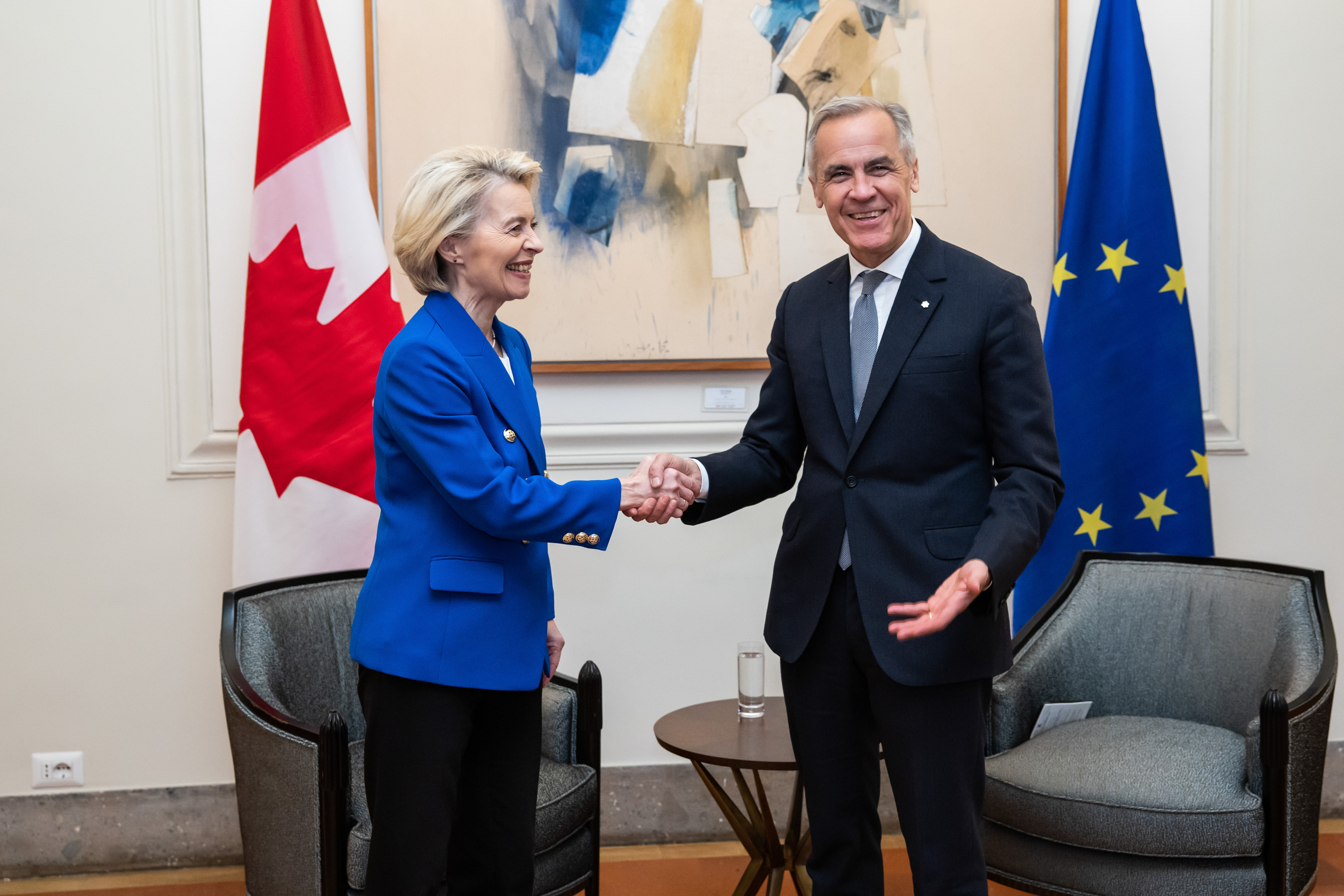
Ursula von der Leyen stood in Strasbourg on Wednesday, looked across the chamber at Mark Carney, and said she wanted to "open the door" for Canada to become the European Union's first associate member. It was the line of the State of the Union, and it was not in the leaked draft. It also came a few hours after five EU diplomats had told the Financial Times that national capitals had rebuffed Ottawa's request for a "unique alliance" with the bloc.
That sequence is the story. The Commission president has put a name on a relationship that the member states, who would have to create it, had already declined to upgrade. And by nightfall the White House had turned it into a trade dispute.
Von der Leyen said the EU wants to take relations with Canada "to the highest level possible". The draft speech that circulated overnight had talked about an "Alliance for the Future" built on the 2017 trade deal, CETA, with deeper cooperation on critical raw materials, energy, defence and technology. What she added on the day was the label: associate membership.
Canada also appeared in the second big announcement, a European Security Council that would bring together leaders of the EU, Britain, Norway, Ukraine and Canada. That body would sit outside the EU treaties precisely so that non-members can join, and von der Leyen paired it with a proposed emergency security protocol modelled on NATO's Article 4, under which any EU state facing a serious threat could call an urgent meeting. Add the fact that Canada was the first non-European country admitted to the SAFE defence-procurement instrument in February, and the first non-European leader at the European Political Community in Yerevan in May, and the direction of travel is clear.
What was not offered is any definition. No such category exists in the treaties. Creating one would require unanimity and ratification by 27 parliaments. The models that do exist, the European Economic Area for Norway and Iceland or Switzerland's bilateral web, oblige the partner to adopt EU law it has no vote on. Nobody in Ottawa has suggested Canada would accept that, and Carney himself spent the weekend damping down the "associate membership" idea after it surfaced from Brussels rather than from his own office. A senior Renew Europe figure conceded on Tuesday that the practical prize remains getting France and Belgium to ratify CETA; only 17 of 27 have done so nine years after provisional application.
The FT reported on Wednesday morning that Carney's charm offensive had failed to move governments wary of giving Canada preferential trade access. The sceptics' counter-offer was pointed: better implementation of the agreements that already exist. There was consensus on one thing, closer work with Canadian arms makers and critical-minerals miners. That is the security-and-supply relationship, not a new political tier.
Commission insiders, for their part, are said to be cool on Carney's language of "middle powers". A bloc of 450 million people, the argument goes, belongs in a different league. So the two sides came to Strasbourg wanting different things: Ottawa wants a coalition of the like-minded against Washington and Beijing, and Brussels wants a flagship partnership it can announce.
Donald Trump did not wait for Carney's speech. Speaking to reporters on Wednesday, he called the associate-membership idea "laughable", said Canada had been "a terrible trade partner", and warned that if he judged the move "at all a hostile act" he would impose "very serious tariffs" or stop trading with Europe "on many things". The Handelsblatt morning briefing led its European section on the threat.
Von der Leyen had insisted the partnership was "not against anyone else". She did not name the United States once in the speech, a pattern the Brussels commentator Dave Keating has tracked for two years: Washington is named when the news is good and left unnamed when it is not. Trump named himself into the story within hours.
Carney addresses the Parliament this morning, with von der Leyen in the chamber after her spokeswoman was forced on Monday to reverse plans to leave Strasbourg early. He has already told the FT that closer ties would make both sides "more resilient, more independent" and told Bloomberg he wants an arrangement "above and beyond" CETA, including enhanced labour mobility and education links, plus a global "technology stability board" for AI along the lines of the Financial Stability Board. Canada's contribution to the €90 billion Ukraine loan is due to be settled before the EU-Canada summit in Montreal on 29-30 October.
The Parliament's president, Roberta Metsola, will present him with a Canadian MK II steel helmet found near Caen last year, from the 1944 Operation Totalise. The symbolism is not subtle.
Von der Leyen has given Canada something the member states had just refused to give: a headline. Whether it becomes more than that depends on capitals that have signalled they want implementation, not invention, and on a US president who has now attached a tariff price to the word "associate". The useful test for Carney's speech is whether he asks for anything that requires treaty change. If he sticks to CETA ratification, SAFE, critical minerals and a seat at the new Security Council, he is asking for things the EU can deliver this year. The label can wait.