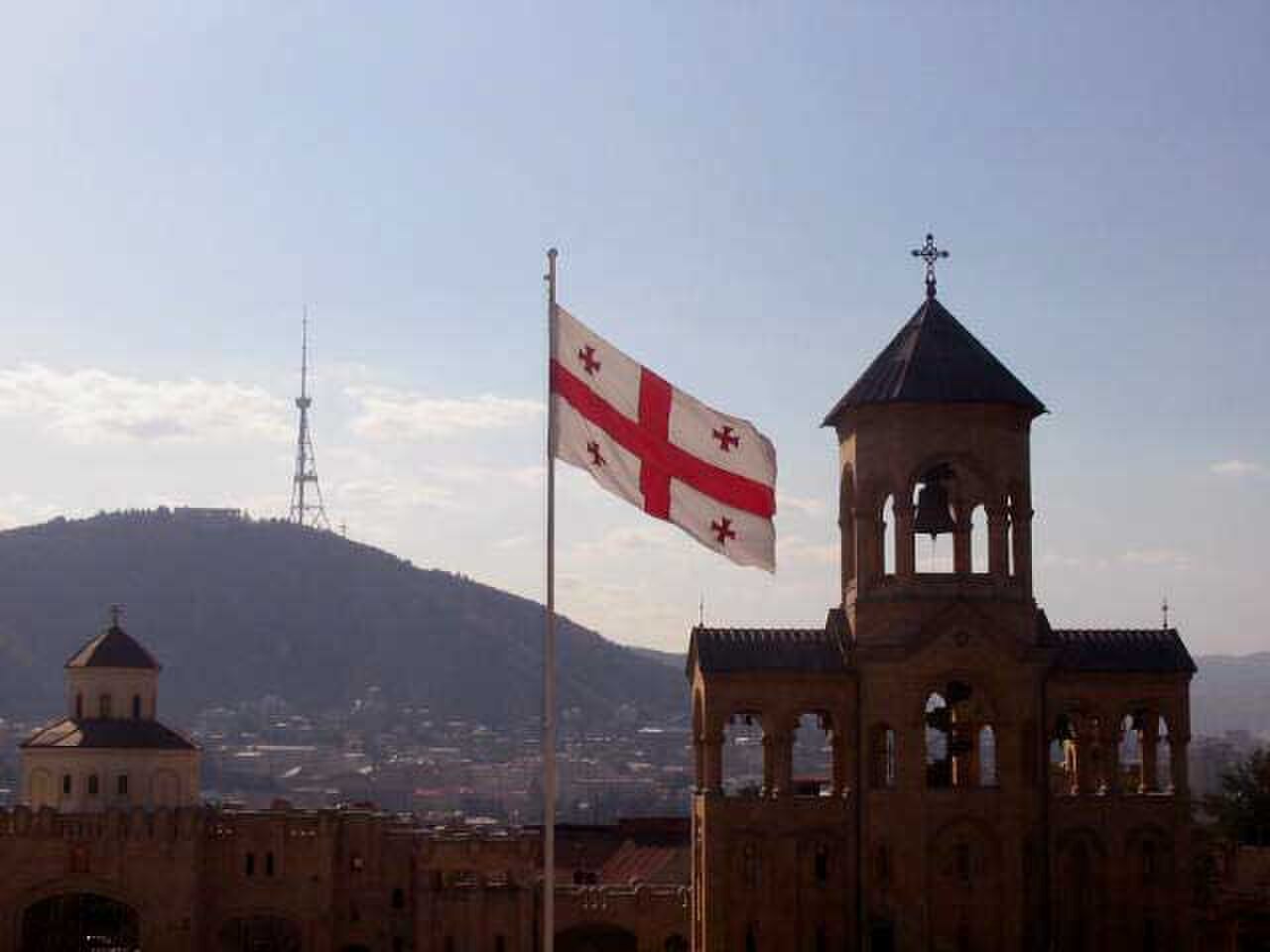
The European Commission's formulation for Georgia is unusually blunt for an institution that prefers hedged language: a candidate country in name only. It is a striking phrase, and like most striking phrases it is hard to argue with and hard to act on. What it lacks is a scale. How much less of a candidate is Georgia than it was, and than everyone else?
EPIC's Integration Readiness Index, published in June 2026 as a study paper with the Friedrich Naumann Foundation and authored by Antonios Nestoras, Emil Kirjas and Bernada Cunj, supplies one. Georgia scores 3.26 out of 10 for 2025. In 2023 it scored 4.06. It is the eighth of ten candidate countries, ahead only of Bosnia and Herzegovina at 2.91 and Türkiye at 2.81, and behind Kosovo at 3.61.
The index rates ten candidate countries from 0 to 10 across the years 2021 to 2025, using five indicators: State of Play, Annual Progress, Recommendation Delivery, Chapter Status and Accession Momentum. Its benchmark is Croatia in 2011 — the last country to actually complete accession — so a score describes distance from a finish line that has been crossed, not from an abstraction.
The methodological choice that matters most is the sourcing. The index draws exclusively on European Commission progress reports. It adds no field research, no expert survey, no separate scoring panel. That makes it narrower than a full country assessment and unusually hard to dismiss: every point Georgia has lost since 2021 is a point deducted on the basis of something the European Commission wrote about Georgia. The verdict and the arithmetic come from the same office. When the Commission says candidate in name only and the index says 3.26, those are not two opinions. They are one assessment expressed twice.
The political chronology is well documented. In June and October 2024 the European Council concluded that the Georgian authorities' course of action jeopardised the country's European path and had de facto halted the accession process. In December 2024 it recorded its regret at the Georgian government's decision to suspend the accession process until 2028 — the government's position being that it had paused the track rather than abandoned it, a distinction Brussels has declined to accept. The Commission subsequently downgraded high-level political contacts, suspended bilateral assistance that directly benefits the authorities, and increased support for civil society and independent media instead.
What the index adds is the timing. Georgia was at 4.06 in 2023, before the formal rupture. By 2025 it was at 3.26. A country does not lose eight tenths of a point on a ten-point scale because of a single announcement; it loses it because the underlying indicators — recommendations delivered, chapters advanced, annual progress recorded — stop producing anything to score. The freeze of 2024 was the political expression of a trend the Commission's own reporting had already been picking up. That is worth stating precisely, because the standard account of Georgia treats 2024 as the moment everything changed. In readiness terms, 2024 confirmed a direction rather than setting one.
The bottom of the table is where this gets awkward for the enlargement policy rather than for Georgia. The 2025 field runs Montenegro 6.8, Albania 6.7, Moldova 5.87, Ukraine 5.85, Serbia 5.5, North Macedonia 5.5, Kosovo 3.61, Georgia 3.26, Bosnia and Herzegovina 2.91, Türkiye 2.81.
Georgia, whose government has explicitly asked for the process to stop, still outscores two countries whose governments say they want in. Türkiye has been a candidate since 1999 and is less ready in 2025 than it was in 2021, when it scored 3.25. Bosnia opened negotiations in March 2024 and then fell from 4.14 to 2.91 in a single year. On the index's own logic these are three different failures — a country that withdrew, a country that stalled to a standstill over two decades, and a country that regressed immediately after being rewarded — and they land within half a point of each other.
That clustering is the finding worth carrying. A readiness score cannot distinguish between a candidate that does not want to join and a candidate that wants to join and cannot deliver. From the point of view of the acquis, they look identical. Which means the EU's most powerful lever, the offer of membership, produces the same measured result whether it is refused or accepted without follow-through.
There is a reasonable objection to all of this, and it should be stated. An index built only on Commission reports inherits the Commission's blind spots and its political timing: if Brussels is slow to write down a deterioration, the index is slow to score it, and if Brussels has reasons to be generous to a strategically useful partner, the index will be generous too. The trade-off is deliberate — the index buys immunity from accusations of external bias by accepting institutional bias instead — but it means the scores describe the EU's assessment of readiness rather than readiness itself. Those are not always the same thing.
The next test arrives with the autumn 2026 Commission progress reports, which will supply the raw material for the next round of scoring. For the eight countries still actively negotiating, that is a routine checkpoint. For Georgia it is something stranger: an assessment of a process that one of the two parties has asked to stop, conducted by the other party, feeding an index that will produce a number regardless. If the score falls again, it will not be because Tbilisi failed to meet a deadline it accepts. It will be because the Commission keeps measuring, and the machinery of enlargement has no setting for a candidate that has walked away. The value of the number, in the end, is that it stops the argument being purely rhetorical. Candidate in name only is a judgement. 3.26 is a starting point for asking what, precisely, the name is still doing there.